
History repeats: The high stakes of the digital divide for seniors and why it matters.
2024 What's Next Longevity Venture Summit (online)
2024 Longevity Venture Summit (DC)
Internet use reduces depression in the elderly by 20%. Whew. I've got to read those news alerts more carefully -- looks like I missed quite a bit of press about the October 15 announcement of a Phoenix Center Policy Paper of data analysis and conclusion by George Ford and Sherry Ford. The news articles about the study are quite confusing -- mixing up terminology (elderly? seniors?) so let's look more closely at the process that produced the conclusion.
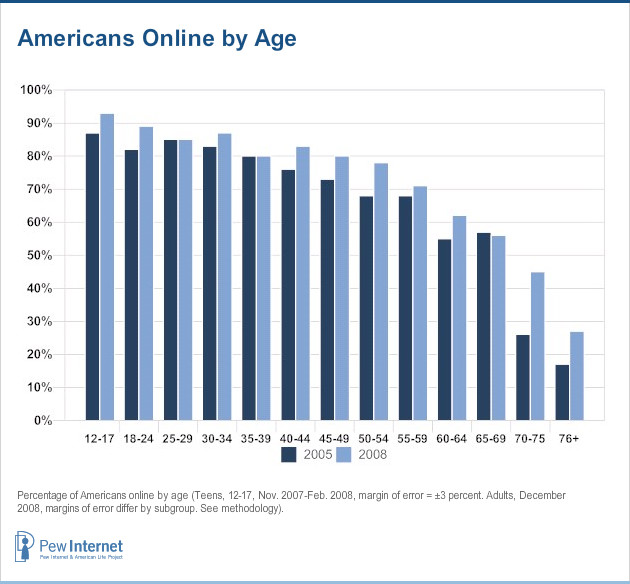
Promote access to the Internet among all older adults. We know that the Internet can provide everyone with access to information they need and connection to others that would keep their minds sharp and their lives engaged with others. The stimulus package (ARRA 2009) mentioned intent of the funds to 'organizations that facilitate' increasing broadband access to multiple populations, including the 'aged'. But I don't think we should be investing too much attention to the younger end of the study's population (that is the 55-64 age range) who are already mostly online.
Remember the required associated support. A big, big issue is buried in these numbers. We must make sure that we accompany investment in broadband with support, especially for older adults who are the least connected. Guarantee that any broadband expansion for this population has the right level of access services, training, software, and personal support services. At the higher age ranges, offer a reason to give it a try beyond potential reduction of depression -- which is an outcome, not a destination. I am not sure that benefit would be obvious to seniors considering whether to go online.
The next study -- a few requests. a) Limit the study population to age 65+, b) Do not exclude those who are working, since they seem to be healthier overall, c) Do detailed analysis of the attributes of age 75+. As part of promoting broadband access, we should understand more about the population that is NOT online today.

Comments
I am so tired of research on
I am so tired of research on "older adults" being done on 50 and over... 50!!?? Get real people--I work at a CCRC and average age is 80+. Let's see some studies out there that focus on the true "older adult", those 70 and older.
75+ statistics
These statistics are encouraging for boomer+ adoption. I agree with Courtenay and have seen experience that internet (especially broadband) adoption tapers exponentially after around 75 years of age. I would also love to see the statistics for this category.
Blog post updated with Pew Internet Use by Age (2008)
Age 76+ is approaching 30%. I would not be surprised to see it cross that in 2009.