
Related News Articles

01/09/2026

The growing ecosystem of devices and products serving peoples’ health and well-being shows us that innovators already see the opportunity to serve the fast-growing market for self-care among people 50 years of age and up. 

01/08/2026

For nearly twenty years, one thing has felt inevitable: when boomers reach “old age,” senior living demand will surge. And yet ..

01/08/2026

ChatGPT Health builds on consumer use of today's ChatGPT so responses are informed by your health information and context. 

01/08/2026

The prize honors .lumen’s Glasses for the Blind, an AI-based device that applies autonomous driving technology adapted for pedestrians. Using computer vision and local processing, the headset understands the three-dimensional environment in real time without relying on the internet or pre-defined maps and guides the user through subtle vibrations indicating a safe direction to follow.

01/03/2026

The United States faces a fundamental mismatch between surging demand and insufficient capacity.
Monthly blog archive

You are here

The care future for older adults needs housing and tech support

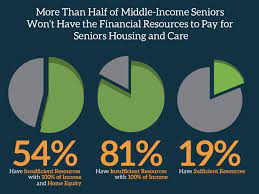
The Harvard study describes a bleak care future. And the NORC study underscores the housing problem for the Forgotten Middle.  Life expectancy for the 65+ is another 20 years on average.  But only 14% of Americans can afford long-term care in the home. And if they could afford it, only 4% of their homes are aging-ready. Nor are they telehealth-ready – where 36% of Americans do not have high-speed internet in the home. For low-income individuals, home and community based services may have a 3-year wait to obtain them. Further, 42% of women aged 75+ live alone

So by now, you’d expect lots of helpful ideas to proliferate.  Maybe there will be new remote monitoring technologies, proliferation of software – the AI Caregiver as one example – to help.  Or the tech-powering of home health and home care agencies (soon?) to supplement in-person care. We’re still (mostly) talking about tech in the home to help family caregivers.  The shortage of care workers within the next decade is daunting – it spans all aspects of care.

By now you would think closing these gaps in care would be likely.  You would be wrong.  Housing alternatives (like cohousing or multi-generational housing) would be well publicized and on the way to broad adoption. Yet all still seemed like niche ideas, not helping those women aged 75+. Senior living – unless a very expensive house is sold  – is not within reach. Home remodeling for aging in pace?  Expensive for many types of homes with second story bedrooms and inaccessible bathrooms.

Into this picture, what tech can be somewhat helpful? Maybe wearables, remote monitoring, telehealth, voice tech – individually fairly inexpensive and prescribed by a doctor or recommended by a family member or neighbor.  Maybe soon, integration of inexpensive smart home technologies into a hub – as proposed by Joseph Coughlin at the MIT AgeLab or described at the UPitt Healthy Home Laboratory.  By now, all of these should be integrated into a low-cost platform, as a plug-in suite sold by Amazon, Best Buy, Walmart or Home Depot, spanning broadband access, lighting, sound, temperature control, health and safety status monitoring. You should be able to obtain a cheap package, perhaps subsidized if needed. In what year? And from whom?

Categories
