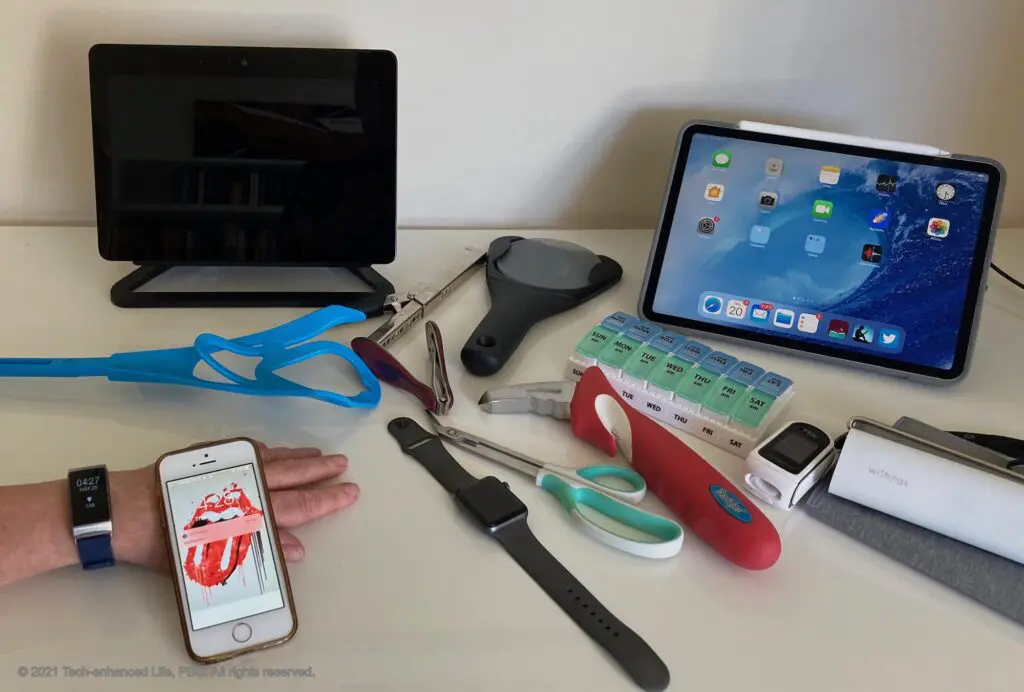
 Fifteen years is a long time in the tech world. In 2011, 30 executives across the tech industry were queried about how technology needed to change to accommodate older adults. Opinions in this AARP-sponsored report were obtained from Intel to HP to Google to Cisco to Microsoft to Philips, from Stanford to Georgia Tech to UCLA as well as multiple futurists and startups. The report is not on the AARP website any more, understandably because it is too old – but can be found here: Connected Living for Social Aging: Designing Technology for All.
Connectivity as well as the tech experience for older adults in 2011 was mediocre. The broadband ‘progress’ report of 2015 confirmed that rural areas lacked it. Note how the FCC was apologetic at its previous pathetic benchmark speed. But connectivity, while critical to actually using the Internet, was not the only limitation. Tech awareness programs were lacking and training was spotty and local. The devices themselves (swiping on tablets and newly available smartphones) were not intuitive. Even when available, adoption of tech by older adults was poor – and the startup user experience, when they could acquire these enabling devices, was lousy. Not interested, not connected to others through the social networking afforded by the Internet – it was another world, unexplored and perceived as less than useful.
The report’s vision – Social Connection and Technology Designed for All. The concept was a repudiation of the poor choices and lousy performance of 2011 tech life. Instead:
“User experiences that appeal to all age groups, persisting across versions and devices.”
Personalized and adaptive – and it came to pass. “Persisting” (being remembered) is expected now for all connected devices. We can select a narrow subset of capabilities that meet our needs. Unfortunately, we need to start over every time we get a different device (or car). Within a family of devices, however, personalization (and our profile) is mostly remembered. Functionality and a profile for some apps (like Netflix) are stored in the ‘cloud’ and thus mostly remembered. Accessibility, mandated in 1990 with the passing of the ADA.
Connected living – was about SOCIAL connection – today enabled (mostly) by tech. The disconnected age of 2015, especially for older adults, is a sad memory. Tech industry age bias was exposed but mostly ignored. However, during the pandemic, for many the Internet was THE ONLY social connection possible – and exposed the lack of access and near-complete isolation of the oldest adults. Thus the pace of older adults moving online accelerated. Today’s grandchildren are online. Families expect instant messaging and face-to-face get togethers. Most older adults would laugh at having to be trained to send or receive a text message – or to grasp the utility of a tablet device in their lives. But those transitions took a while. Now the baby boomers are turning 80 at the pace they once turned 65, straight into the chasm of fragmented healthcare and disability-focused marketplaces. The report’s scenario of an 80-year-old not needing to charge her phone due to its months of battery life, would be laughable to today’s iPhone and watch users, where the devices are exhausted by evening.