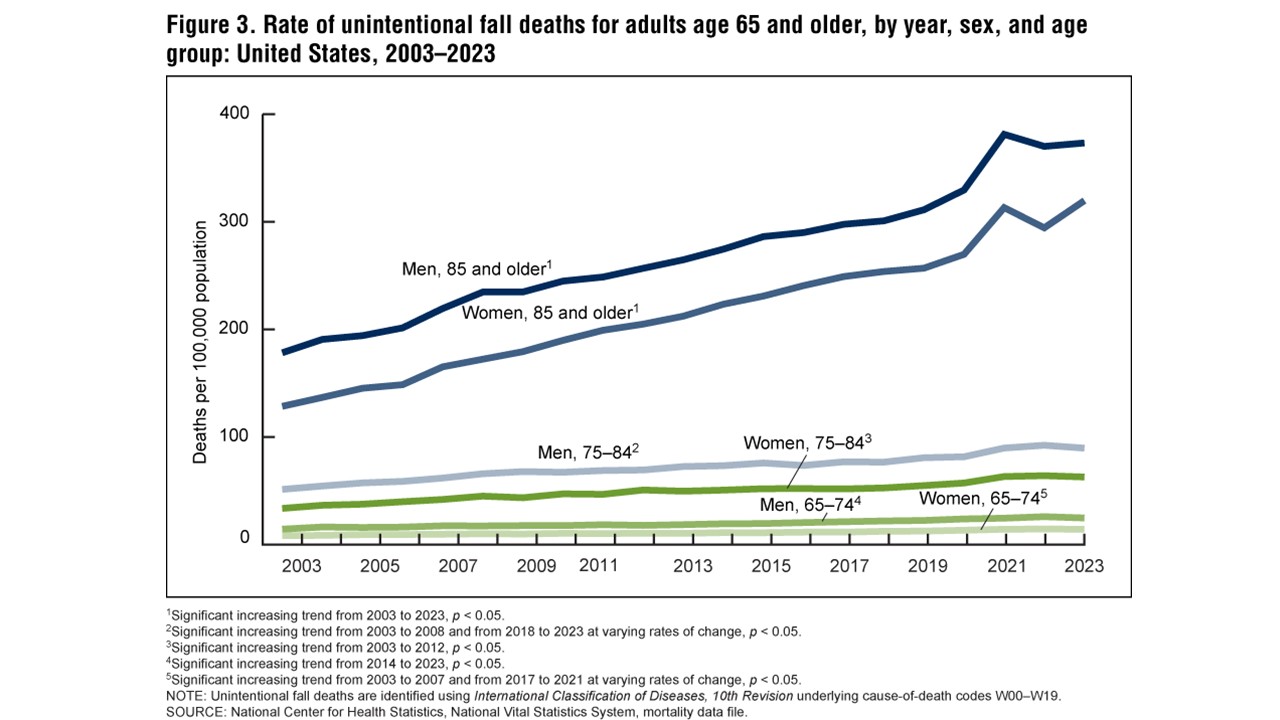
 Falls are a serious problem among the oldest adults. No one can question the statistics - falls are the leading cause of injury-related death among adults ages 65 and older, and the fall death rate increased by 21% from 2018 to 2024. The Senate’s Committee on Aging has taken note – and this week has launched a request for more tech-enabled innovation. Note the chart below and the increase among the population aged 85 and older. Also interesting to note that life expectancy has increased during this period – resulting in more people living past age 85. In fact, mortality rates for older men have been decreasing at a faster rate than for women.
But fall detection – and some prevention -- technology have been around for years. Scanning the links on this website indicates a ramp up on the topic at least fifteen years ago – remember Wellcore in 2011? AT&T’s EverThere? Radar (The Atlantic) in 2014? GreatCall in 2015? With virtually no exceptions, prevention was not discussed until 2017 – first by considering gait analysis. Unfortunately, gait analysis never really went anywhere, despite multiple product innovations and grants. Balance exercises have gained focus in recent years, and strength training has received attention as a fall prevention technique. More recently, multiple companies, including SafelyYou, Inspiren’s Augi, Virtual reality tech, and many wearables, the most famous was the introduction of fall detection in the Apple Watch.
So will this Senate initiative make a difference? Based on the chart below, only if it focuses on the oldest age group, which as usual, it doesn’t. Instead, it appears to lump the population into the usual aged 65+. Perhaps it is time to redefine the word ‘senior,’ drop inclusion of aged 65-75 (despite the start date for Medicare enrollment). Instead (again see chart), with longer life expectancy, focus on offering government funded technology assistance to those age 80+, especially in rural areas, and offer a free fall-detection wearable at senior centers around the country.
Instead, for the 65-80 age range, focus on exercise and strength-training. Regardless of the geography, senior centers everywhere can offer bone health education, as recommended by NCOA. Or strength training as suggested by AARP. Or suggest wearables that are motivators for exercise – like the stand suggestion, movement tracking and exercise suggestions from smart watches. And how about a Senate-initiated effort to partner with health insurance companies to provide smart watches to all older adults who do not have them?